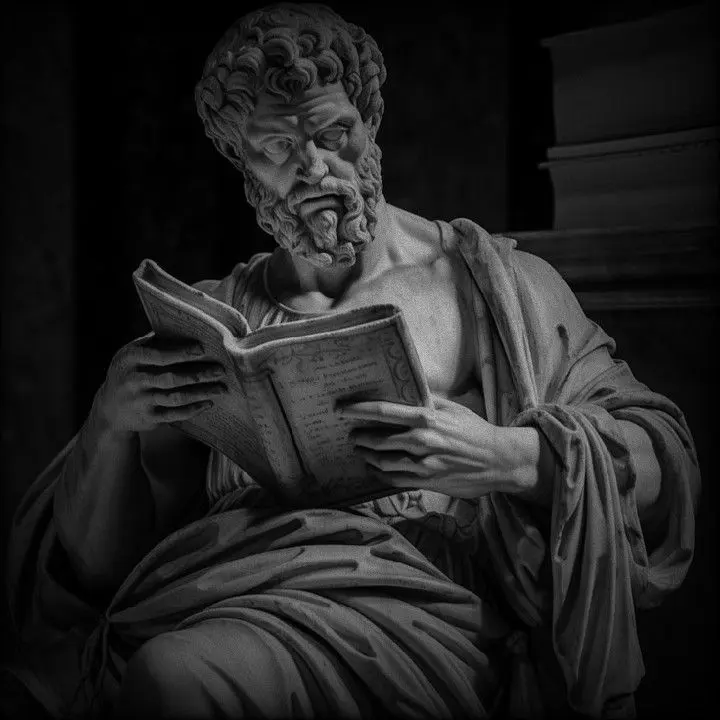
Who is really pulling the strings?
There is something strange about the way we think about freedom.
We imagine a prisoner behind bars.
Someone being ordered around by their boss.
Someone trapped in a bad relationship.
Someone being controlled by another person.
And naturally, we think:
I would never let someone control me like that.
But Marcus Aurelius, the Roman emperor and Stoic philosopher, had a rather uncomfortable way of looking at the problem.
He essentially asks us to imagine how ridiculous it would be to allow another person to jerk us around whenever they wanted.
Imagine someone walking up to you and saying:
“Eat those cookies.”
You'd probably tell them to mind their own business.
Then they say:
“Get angry.”
You'd probably think they're insane.
“Be afraid.”
“Why?”
“Feel miserable because something went wrong.”
“Why the hell are you telling me how to feel?”
And yet...
We obey these commands all the time.
Just not because another person gives them to us.
Our impulses do.
Something goes wrong.
Be miserable.
Someone insults you.
Get angry.
You see something you want.
Take it.
You become afraid of something that hasn't even happened.
Worry about it.
Someone says something you don't like.
Argue with them.
And we rarely stop to question the command.
We simply obey.
THE PUPPET
This is where Marcus' idea becomes interesting.
A puppet doesn't necessarily know that it is being controlled.
It simply moves whenever the strings are pulled.
And perhaps human beings aren't so different.
Your anger pulls one string.
Your fear pulls another.
Your cravings pull another.
Your jealousy pulls another.
Your anxiety pulls another.
Something happens, and suddenly you're moving.
Not because you consciously decided to.
Because something inside you pulled the string.
That's the uncomfortable part.
You might think you're an incredibly independent person.
You make your own money.
You live your own life.
You don't let people tell you what to do.
You tell everyone to fuck off when they cross your boundaries.
Congratulations.
But what happens when someone insults you?
Do they control your mood for the next six hours?
What happens when something doesn't go according to plan?
Does it control your entire day?
What happens when you want something badly?
Can you tell yourself no?
What happens when you're afraid?
Can you still act according to your judgment?
Because if the answer is no, perhaps you're not as free as you thought.
FEELING ISN'T THE SAME AS OBEYING
This doesn't mean Marcus Aurelius wanted people to become emotionless robots.
Stoicism isn't about never feeling anger, sadness, fear, excitement or desire.
You are human.
You will feel things.
The important question is what happens after the feeling arrives.
Imagine someone insults you.
Your first reaction might be:
“I'm angry.”
That's normal.
But then comes the important question:
“Do I actually want to respond?”
That tiny gap between the feeling and the action is incredibly important.
You can be angry without becoming cruel.
You can be afraid without running.
You can want something without immediately taking it.
You can be hurt without trying to hurt someone else.
The emotion can exist.
You simply don't have to hand it the steering wheel.
LOOK AT YOUR LIFE FROM THE END
Marcus also had another uncomfortable habit.
He liked reminding himself that he was going to die.
Not exactly cheerful dinner conversation.
But there was a reason for it.
Imagine yourself as an old person looking back at your life.
You've got very little time left.
Then ask yourself:
Was this really how I wanted to spend it?
Being furious because someone insulted me?
Worrying about something that hadn't happened?
Arguing with strangers?
Chasing every temptation?
Being miserable because reality didn't obey my expectations?
Allowing every temporary emotion to decide what I did?
When you look at your life from that distance, some of the things that felt incredibly important suddenly become embarrassingly small.
That argument?
Gone.
That insult?
Forgotten.
That thing you desperately wanted?
Eventually replaced by something else.
That fear that consumed you?
Perhaps it never even happened.
And yet, while living through those moments, we allow them to completely possess us.
A DIFFERENT DEFINITION OF FREEDOM
Maybe freedom isn't simply being free from other people.
Maybe freedom also means being free from your own compulsions.
Because you can escape an abusive relationship and still be controlled by anger.
You can quit a terrible job and still be controlled by fear.
You can live alone and still be controlled by loneliness.
You can have money and still be controlled by greed.
You can have nobody telling you what to do and still spend your entire life doing exactly what your impulses demand.
That is a strange kind of prison.
There are no walls.
No guards.
No chains.
Just strings.
And perhaps the most important form of independence isn't being able to tell everyone else:
“You don't control me.”
Perhaps it's being able to tell yourself:
“I don't have to obey every feeling that appears inside me.”
You feel anger.
You pause.
You feel fear.
You pause.
You feel desire.
You pause.
You feel sadness.
You pause.
Not because the feeling isn't real.
But because you are more than the feeling.
And somewhere in that pause is a little piece of freedom.
Maybe that's what Marcus Aurelius was really asking us to examine.
Not whether someone else is controlling us.
But whether we are constantly handing control to whatever happens to pull the strings.